• ORORUN

  • ORORUN

  • ORORUN

  • ORORUN

  • ORORUN

  • ORORUN

EXECUTIVE SUMMARY

I led the end-to-end product strategy, UX architecture, and UI design for Ororun, turning a highly fragmented legal landscape into a unified, production-ready platform. By designing for technical scalability and operational realism from day one, I delivered a modular multi-vertical system (Research, Careers, and Events) that launched into active beta with zero operational overhead for the founding team.

METADATA

My Role:

Team:

Timeline:

Lead Product Designer (end-to-end UI/UX and product architecture)

1 PM, 1 Full-Stack Developer, Me

5 months, strategy through production-ready handover

SCROLL

Core Platform Benchmarks (System & Operational Impact)

Core Platform Benchmarks (System & Operational Impact)

Core Platform Benchmarks (System & Operational Impact)

Ororun set out to unify three things legal professionals normally track in separate places research, careers, and events into one product. With a team of exactly three people, the real constraint wasn't taste, it was buildability: every design decision had to survive being implemented by a single developer on a five-month clock.

3

Verticals Unified:

Research, Careers &

Events in one interface

0

Developer Overhead

for Content Ops via

custom admin tooling

100%

Production Ready

Handover & Active

Beta Architecture.

The Landscape (Context & Core Friction): Lawyers weren't short on tools they were drowning in them. Legal research lived in dense legacy databases, job listings sat in generalist boards with no legal context, and industry events were scattered across whatever ticketing platform the organizer happened to pick.

The Landscape (Context & Core Friction): Legal professionals don't lack tools they suffer from platform fatigue. Existing legal tech platforms are fragmented ecosystems. Research lives in dense legacy databases, career opportunities are buried in generalist job boards, and professional events are scattered across generic ticketing sites. This forces lawyers to constantly context-switch, resulting in lost billable hours and broken workflows.

The Landscape (Context & Core Friction): Legal professionals don't lack tools they suffer from platform fatigue. Existing legal tech platforms are fragmented ecosystems. Research lives in dense legacy databases, career opportunities are buried in generalist job boards, and professional events are scattered across generic ticketing sites. This forces lawyers to constantly context-switch, resulting in lost billable hours and broken workflows.

One person, four logins.

One person, four logins.

One person, four logins.

Users were managing 3–4 separate accounts across disconnected platforms just to do one job.

Users were managing 3–4 separate accounts across disconnected platforms just to do one job.

Text with no hierarchy.

Text with no hierarchy.

Text with no hierarchy.

Legacy legal databases treat every result the same — dense, flat, and exhausting to scan under time pressure.

Legacy legal databases treat every result the same — dense, flat, and exhausting to scan under time pressure.

Growth blocked by the backend.

Growth blocked by the backend.

Growth blocked by the backend.

Publishing anything new meant a manual database entry, so content operations couldn't move faster than engineering could type.

Publishing anything new meant a manual database entry, so content operations couldn't move faster than engineering could type.

Tunde Akintayo

Researching case law feels like using the internet in 2003. I waste half my night fighting ugly, broken databases when I just need one solid precedent

Tunde Akintayo
Senior Corporate Associate
Tunde Akintayo

Researching case law feels like using the internet in 2003. I waste half my night fighting ugly, broken databases when I just need one solid precedent

Tunde Akintayo
Senior Corporate Associate
Tunde Akintayo

Researching case law feels like using the internet in 2003. I waste half my night fighting ugly, broken databases when I just need one solid precedent

Tunde Akintayo
Senior Corporate Associate

Strategic System & Design Decisions

Strategic System & Design Decisions

Strategic System & Design Decisions

1. Making dense legal text scannable

1. Making dense legal text scannable

1. Making dense legal text scannable

Legal data is inherently text-heavy, making rapid scanning difficult. Traditional legal search interfaces often dump flat, unorganized lists of documents onto the user.

The Friction

Legal research queries routinely return hundreds of flat, unranked results technically complete, practically unusable.

The Design Solution

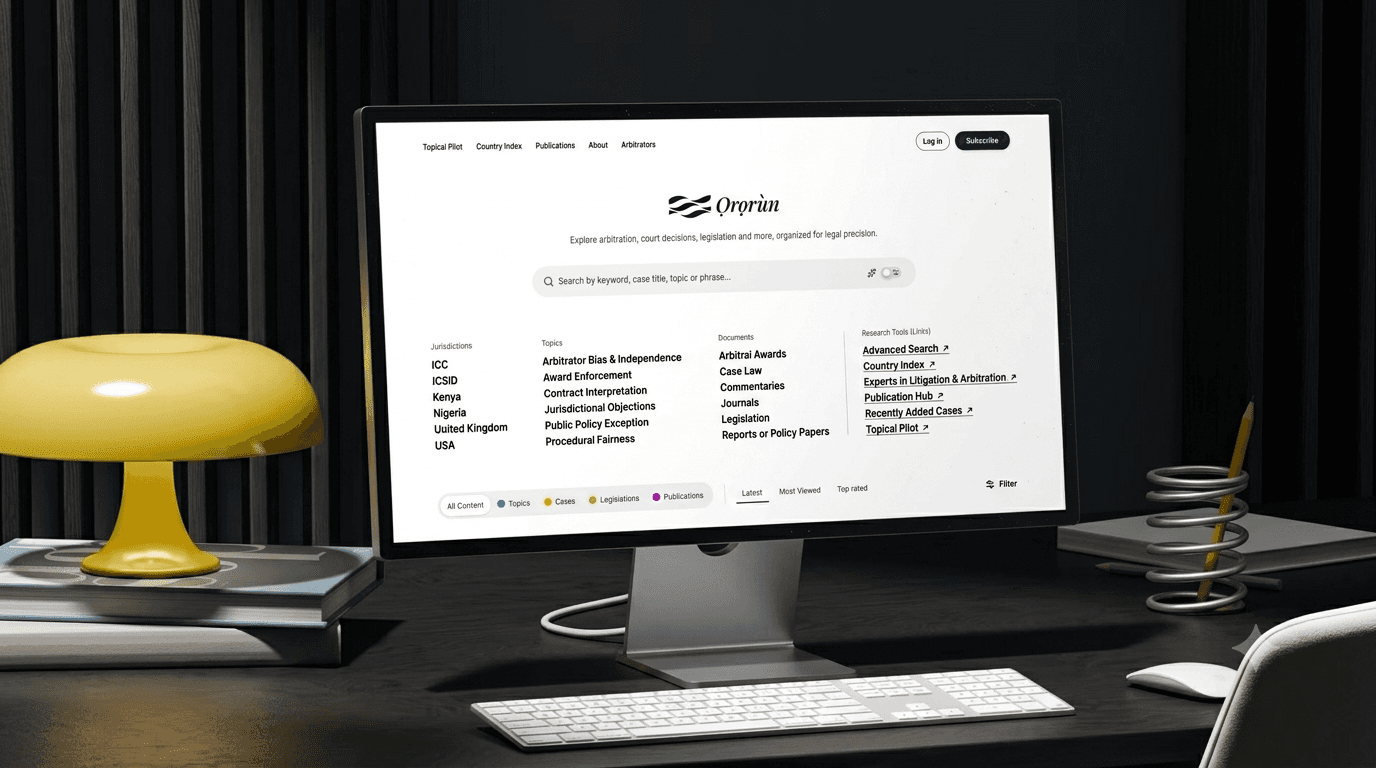
I built a hierarchical "Topical Pilot" structure paired with a dual-pane Case Viewer, so curated summaries map directly to their parent legal topics and sit side-by-side with the raw case text.

The Polish:

A strict typographic scale and deliberate padding rules kept dense citations readable over long research sessions, rather than turning into a wall of legalese.

2. Choosing what not to build

(Careers & Events Marketplaces)

Building proprietary job-application tracking systems (ATS) or secure financial ticketing architectures from scratch would have consumed months of development time and bloated the product scope.

The Friction

A real applicant tracking system and a secure ticketing platform are each their own multi-month builds neither fit inside a five-month runway with one developer.

The Design Solution

I scoped Careers and Events as lightweight discovery layers instead of owned systems surfacing listings and events, then handing off to each employer's or organizer's existing platform via clean external redirects rather than rebuilding their infrastructure inside Ororun.

The Result

This cut an estimated 3 months off the engineering roadmap and let Ororun host a genuinely active careers and events ecosystem without taking on the liability of running payments or applicant data itself.

3. Treating the admin tools as a real product

3. Treating the admin tools as a real product

3. Treating the admin tools as a real product

A common pitfall in complex platforms is ignoring the internal tools. If the client’s team has to rely on manual database scripts to upload legal texts or approve job listings, the product cannot scale.

The Friction

A platform with three content verticals is dead on arrival if approving a user or publishing a document requires someone to write raw database scripts.

The Design Solution

I spent a full project phase designing a role-based internal Admin Dashboard bulk upload tools, taxonomy management, and content moderation queues with the same care usually reserved for the user-facing product.

The Polish:

Ororun's non-technical team can now manage, gate, and monetize content with zero ongoing developer involvement the platform's ability to scale stopped depending on engineering availability.

What didn't work? Early in the architecture phase, I designed toward a single global feed one unified account tier where any authenticated user could see cases, job postings, and events together, on the theory that maximum visibility meant maximum engagement. An early engineering spike with the developer exposed the problem fast: it broke the privacy expectations enterprise legal firms actually operate under. Firms posting premium roles didn't want candidates or researchers seeing internal structure, and some legal data needed strict gated access a flat feed couldn't enforce. We paused design production for two weeks to rebuild the architecture around a proper role-based permission matrix Candidate, Employer, Researcher, Admin separating public discovery from the authenticated, secured dashboard states. above.

What didn't work? Early in the architecture phase, I designed toward a single global feed one unified account tier where any authenticated user could see cases, job postings, and events together, on the theory that maximum visibility meant maximum engagement. An early engineering spike with the developer exposed the problem fast: it broke the privacy expectations enterprise legal firms actually operate under. Firms posting premium roles didn't want candidates or researchers seeing internal structure, and some legal data needed strict gated access a flat feed couldn't enforce. We paused design production for two weeks to rebuild the architecture around a proper role-based permission matrix Candidate, Employer, Researcher, Admin separating public discovery from the authenticated, secured dashboard states. above.

Gallery Showcase

Gallery Showcase

Gallery Showcase

A curated look at the final, component-driven UI. This section highlights the responsive grid systems, the clean visual hierarchy applied to complex legal documentation, and the modular UI states designed for different user permissions.

What We Learned & What’s Next?

What We Learned & What’s Next?

What we Learned & What's Next?

Data Models Drive Design:

Complex UI design cannot happen in a vacuum. Working alongside a single developer proved that visual decisions must map cleanly to underlying database permissions and roles to be viable.

Where it stands now

fully handed over, running in closed beta with legal firms. Next iteration focuses on tracking behavior across the three verticals to improve conversion on premium employer listings.

Sustainability Wins:

A product's longevity is quietly determined by the efficiency of its admin tools. Designing internal operational UIs concurrently with public-facing ones is mandatory.

Data Models Drive Design:

Complex UI design cannot happen in a vacuum. Working alongside a single developer proved that visual decisions must map cleanly to underlying database permissions and roles to be viable.

Sustainability Wins:

A product's longevity is quietly determined by the efficiency of its admin tools. Designing internal operational UIs concurrently with public-facing ones is mandatory.

Where it stands now

fully handed over, running in closed beta with legal firms. Next iteration focuses on tracking behavior across the three verticals to improve conversion on premium employer listings.

Data Models Drive Design:

Complex UI design cannot happen in a vacuum. Working alongside a single developer proved that visual decisions must map cleanly to underlying database permissions and roles to be viable.

Where it stands now

fully handed over, running in closed beta with legal firms. Next iteration focuses on tracking behavior across the three verticals to improve conversion on premium employer listings.

Sustainability Wins:

A product's longevity is quietly determined by the efficiency of its admin tools. Designing internal operational UIs concurrently with public-facing ones is mandatory.

Ready to ship? Let’s talk numbers and systems.

Ready to ship? Let’s talk numbers and systems.

Ready to ship? Let’s talk numbers and systems.

TO GET IN TOUCH

Contact Me

Contact Me

SET UP A DAY TO TALK ABOUT YOUR DESIGN NEEDS

SET UP A DAY TO TALK ABOUT YOUR DESIGN NEEDS

CLICK TO COPY

jayfactor007@gmail.com

Email is in your clipboard!

CREATED BY

JAMES MARTINs

JAMES MARTINS

©

2026

ALL BUILT IN

FRAMER

10:32 PM

August 7

Abuja, Nigeria

Available for work

Check X

Linkedin

Instagram

Email

Behance

Dribbble

Create a free website with Framer, the website builder loved by startups, designers and agencies.